Wednesday, May 26, 2010

Urikaruus, the final episode! (almost!)

As the morning dawned on our final day in this lovely little bush camp, we awoke to find a number of eagles visiting our small haven as they had at various times over the last few days. There was a tawny eagle far away on the other side of the watering hole, just too far for me to get a useful photo. We decided to go out on an early morning drive this morning, and not long after we left camp we saw this eagle with two fork-tailed drongos in attendance.

We had decided to head off in the direction of the lion kill we had seen the day before to see if perhaps there were now other predators or scavengers nosing around what the lions had left behind. Well we were in for a surprise, the lions were still there! This must have been close on 24 hours after they had originally made the kill. There were a number of jackals nosing around in the area, but they were giving the lions a very respectful wide berth. The wildebeest carcass had ben reduced now down to the head and some bones!

This was one of the every hopeful jackals that were patrolling the area.


As we had spent quite a bit of time with these lions the day before we decided to move on, and were rewarded only a few minutes later with the sighting of 3 secretary birds. Two of them were moving in an area quite close to each other and the third was 20 or 30 metres away from them.


As we were watching them one of the birds found something interesting in the grass.

Immediately the other bird rushed over and tried to claim the prize for itself. This started an amazing dance duel!


And just as it started it was over! In fact the time stamps on the three photos above show that each shot was taken one (1) second after the other! So three grand seconds of display and it was all done. Life returned to normal and they continued to forage as they had before.

A little further on we spotted a Namaqua Dove sitting in a tree quite close to the road. These a very pretty little doves (at least in my opinion!) and I had been wanting a decent shot of them for sometime. This was not too bad, but still I'd like to get a better one.

Later on we spotted another secretary bird, some large herds of springbok, one almost get bored with the springbok becuase you see so many. Then a juvenile martial eagle sitting in a tree.


After that we decided to head back to camp and make brunch, we had been out for about two hours and had some nice sightings. I'll leave this post here and wind up our Urikaruus stay in my next post, then we moved on to Nossob .... but that's another days post :-)

all the best
Ivan


Monday, May 24, 2010

The Urikaruus story continues

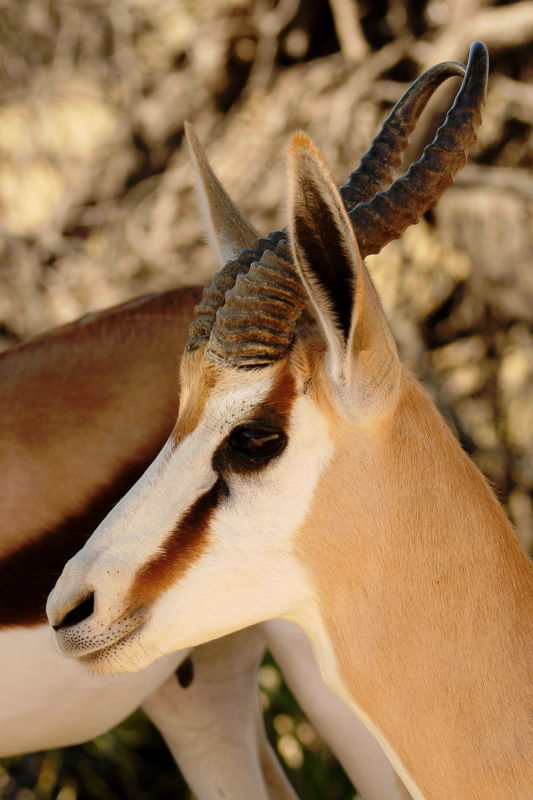
Having had the excitement of the lions at lunchtime we moved back to our camp, on the way we passed a large herd of springbok right on the roadside. This opportunity allowed me to get a real close-up of some of these iconic animals.

Then when we arrived back at the camp there waiting for us at the drinking hole were a herd of giraffe. I watched with interest as these tall animals, that can look so graceful as they wander around the veld, akwardly reach down to get a drink. The shot of this one below had me holding my breath as its legs went wider and wider, occasionally slipped in the mud around the hole and seemed to have incredible flexibility as they bent under the weight and angle, forced by the massive distance the giraffe needs to come down to drink.
The Lanner falcons were also busy around the waterhole, swooping in try to catch a pigeon or two.

Also hanging around trying to look dis-interested were the fork-tailed drongos.


As the afternoon moved on we decided to go out for a short drive. The first new sighting we had was this Capped Wheatear

And then we spotted this little darlings of the desert! The bat-eared foxes. They were just a little too far away and moving further away, and the light was dropping so I struggled to get a decent shot of them, but this one illustrates their classic pose as they search of their evening meals.

We then headed back to camp. Shortly after we arrived back, the giraffe that had been at the waterhole earlier had been replaced by a large herd of wildebeest. I counted more than fifty in this image below, and that was not all of them.

We then settle down to review the photos we'd been taking and prepare for supper. Here is Claire Marie, my younger daughter looking through her pic's from the day.

And of course as it started to get darker, and the moths and other insects were attracted to our lights the geckos came out to feast with us!

I think thats all for this post ... its taken me way too long to get it finished!

all the best
Ivan
http://www.andersen.co.za/

Wednesday, May 19, 2010

In and around Urikaruus - part 5

Well having given you some bugs (spiders!) and birds in my previous post, we'll move to the bigger beasts again for a while! As I had said we were told that there had been a kill just 8km from our camp. There were apparently four lions (Panthera leo) that had taken down a blue wildebeest (Connochaetes taurinus), and were busy eating it near the road. Now I must warn you, some of the images I will post here you may find a little upsetting or disturbing. It is not my intent to do either, but to simply illustrate what we saw and how nature operates in these wilderness areas. If this concerns you, please skip this post and come back tomorrow when I've posted the next installment!

So we headed off in the direction towards Mata Mata hoping that the lions would still be there and we'd be able to see them nice and close. We had seen lion a few days earlier, but they were so far away and lying still in the shade, so we could not get a decent view, never mind a picture, of them.

Well, just as described about 8km up the road we came across the lions and their prize!
This picture is of the younger female (in the foreground), and the two young males behind her. There were fours lions in total. Two older females and two young males. The three in the image above were lying right on the side of the road. The sandbank you can see in the foreground of the picture is the edge of the road!

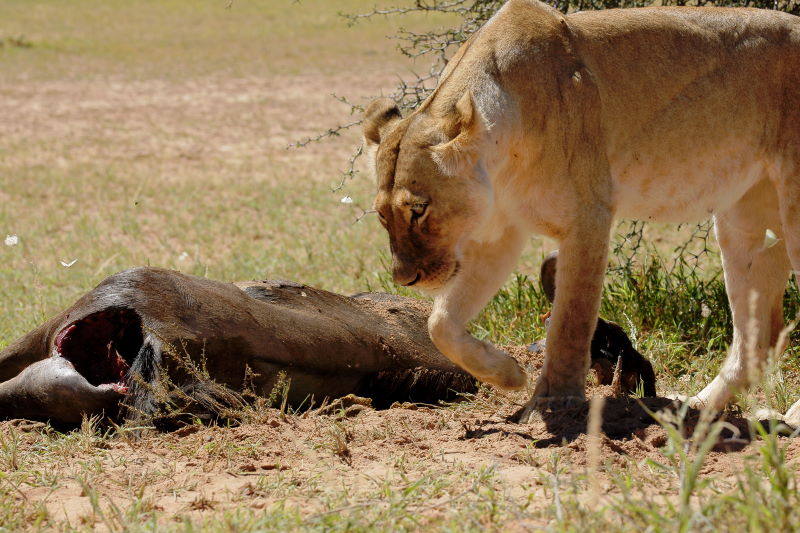
The older of the two females was still nibbling at the carcass of the wildebeest. From this picture and the one following it you can see that the lions had eaten the rump and stomach areas of the wildebeest.

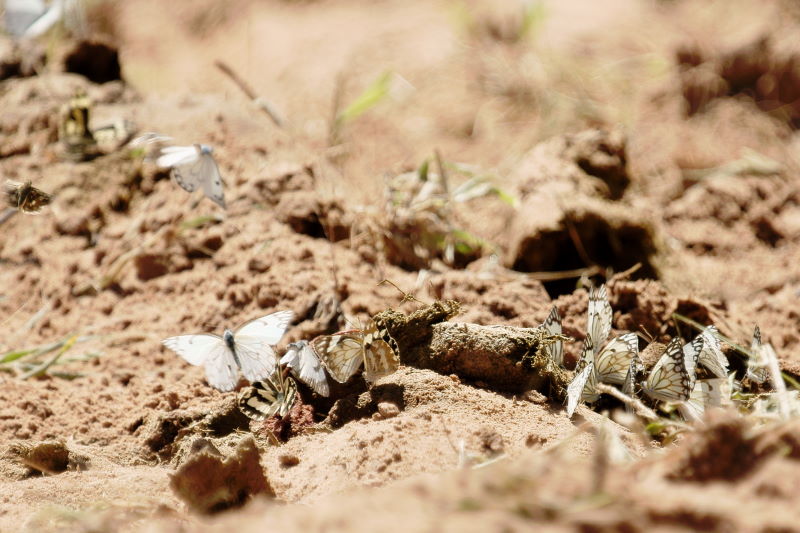
But what I found facinating were the butterflies that hovered around the kill area. Clearly in a world where moisture is at a premium these delicate creatures find something of value in the fluids distributed after a kill like this. Did you notice them in the images above? Take another look, click on the image to get a larger view.


After this lioness had eaten a little more she nochalantly picked up the carcass in her moth and dragged it into the shade of the nearby thorn tree. Now an adult wildebeest, which this clearly was, can weigh anything up to 274kg and the maximum weight a female lion is likely to reach is only 182kg. Ok, sure they had eaten a significant amount of meat off the carcass, but chances are that what remained was as heavy if not heavier than the lioness.

Here she is clearly enjoying another nibble after the exertion of moving the carcass.
What followed next was also, for me, an interesting interaction. Firstly, the lions, all four of them, seemed totally unperturbed and uninterested in the four or five vehicles that had gathered around their lunch table, despite the close proximity. Plus the camera lenses sticking in their faces and clicking sounds of photos been taken and the hum of voices from the various ocupants in the vehicles, all seemed to be of absolutely no interest to the lions at all. But I digress! The lioness that was at the carcass had gotten up and one of the young males had started to move towards her and the wildebeest. 

As he moved past the lioness that had been lying in the shade beside the road with him, he lent down and rubbed his face against hers as she lay there, totally unmoved.   He then moved towards the other lioness near the carcass, her reaction was completely different! She pulled back her ears and snarled at him!
 He simply responded by turning around again and going to lie back down where he had been before!
Just as a matter of interest, for those of you that are a little technical, the shot above of the snarling lioness was taken with 160mm focal length and has not been cropped at ALL. In fact the only shots cropped in this post are the one of the butterflies and the portrait of the male cub. That's how close we were to the action!

all the best

Ivan

Tuesday, May 18, 2010

In and around Urikaruus - part 4

As I mentioned in my previous post this day started well and steadily improved! Firstly I had spotted the this spider


and her web in the early morning light, then as I moved around I saw this one in a bush nearby. Do you see the curious ant possibly heading into the danger zone?


This spider, I think is a member of the sociable web spider family, or community nest spider family. This one was starting a relatively new nest I think. I had seen these nests alnode the road and in the camp and had wondered if they were still inhabited as had been unable to see any spiders in them. On top of this most of the nests I saw appeared so encrusted with dust I wondered if anything could live in there!

Then I spotted these spiders peeking out of this nest. They appeared to have a number of eggsacs too. Here is a closer crop of the photo above.


Enough of spiders .... for now! The day moves on, and we are visited by some large herds of springbok, and some wildebeest. The image below captures part of the herd only!

We counted well over 200 animals in this herd. Then I spotted a crimson-breasted shrike an image of which I posted earlier, and still I was not able to get a really nice shot of this stunning bird.


But here it is again, just because I think the colours are so amazing, even though the shot is lousy! One of the friendly familiar chats popped in too,


as did the glossy starling and of course the sparrow-weaver and family.


Then a fork-tailed drongo came by.


A group of Namaqua Sandgrouse (Pterocles namaqua)  were also making regular visits to the waterhole.

Flying high and calling with their characteristic whistle. We also saw a juvenile marshall eagle and a black-breasted snake eagle. Neither of which came close enough to allow me a decent shot, but I did get pictures of both at other occasions.

Of course the ground squirrels were also doing their usual foraging around, with their portable shade umbrellas working overtime in the harsh light of the mid-morning sun

And then ...... the camp attendant came to tell us that some of the other guests had just returned from a drive and had seen some lion with a kill not far from our camp. So we got a few things together and jumped into the car. But I'll save that story for my next post!

all the best
Ivan

Monday, May 17, 2010

In and around Urikaruus - part 3

Well day two (April 2nd 2010) dawned in Urikaruus, this was after an interesting evening sitting on the veranda cooking our evening meal on an open fire. As night was starting to set in my daughter Claire Marie spotted (no pun intended :-) ) a leopard strolling down out of the bush, almost directly opposite from us, towards the watering hole. She, that is the leopard, was quite nonchalant and disinterested in the hum of exitement stemming from these wide-eyed invaders of what was clearly her home territory. Unfortunately it was too dark, and she was too far away to get any kind of photo of her, so we just sat and watched in the gathering gloom, for as long as we could see her and then returned to our evening meal, as she set off to find hers.

Well, having spent so much time in the car over the first few days of our trip we decided to relax on this morning and see what may make an appearance in and around our camp. I tried to get a few landscape shots from our bedroom veranda just after the sun rose, but I won't bore you with those attempts having already posted some views in my earlier post. Having looked out front and not seen much other than the great view, I then turned my attention to behind the chalet and saw this in the rays of the rising sun!


It must have been there the day before, but it needed the early morning light to reveal it to my human eyes. What an amazing web! The top anchor line stretched probably nearly two metres, you can see it running almost horizontally accross the top of the image. The overall web was about 40-50cm high and about double that in horizontal diameter. One of the amazing things about this web was that it was virtually invisible once the sun got up into the sky.  If you look really closely you can see the spider in the top left part of the middle circle of the web. It just give you a perspective on the size of construction this little lady made!


Still struggling to see her? Well, here's an even closer view.


What amazing colours and shapes she has. She blends in with the natural surrounds incredibly well too.

I'll leave this post here, but this day started well and got better and better. So stay around and I'll tell you more :-)

all the best,
Ivan
http://www.andersen.co.za/

Thursday, May 6, 2010

In and around Urikaruus ... part 2

Relaxing on the veranda of our unit looking over the waterhole in front, wondering what might come along next, I was surprised by this tiny little fuit fly (Rhacochlaena pulchella Bezzi 1920 (Tephritidae: Adramini)) and some of its friends!

I'm not sure if it was after the sweat / salt or dry skin on my leg .... yes, that's my leg it is sitting on! But it did not seem to bite or sting, and when I zoomed in I was amazed at its colours and detail. This prompted me to start looking around for some other smaller occupants of the camp.

The next resident I discovered was this kite spider, she had built her web on the side of the kitchen unit, between it and our bedroom unit.
And what an amazing web. I tried to get a shot that would illustrate the density and complexity of this web. Theses are the best I could do.


The spider you see on the image on the top of the three above, is the black blob on the end of the sausage looking object, more or less in the middle of the image on the left (vertically) and on the left side (horizontally). The image to the right of the two lower images is a landscape crop of the left side image. If you look closely and use your imagination you can see the spider. But what I'm really trying to illustrate here is the density and complexity of her web. Other than webs of sociable spiders, which I'll post later this web has to be the most complex I've seen developed by a single spider.

Another regular visitor at this unit was the Kalahari Tree Skink. There were various members of this family around. This old chap looked rather as if he/she had survived a few wars! But none-the-less was relatively relaxed around us, and would check in every now and again to see if something interesting had been dropped for it to eat.

Then just to round off this post and the day, I spotted this little web glistening in the setting sun. I never discovered the occupant as it was quite high in a tree, and out of reach from the chalet veranda. I liked the way the sunlight picked up the strands, and I think it was possibly another kite spider.

And then to finish this post, one of the other regulars where ever we went. The yellow mongoose, put in and appearance, always alert always interested.

all the best,

Ivan


Tuesday, May 4, 2010

In and around Urikaruus

Whew, its been a mission getting back on-line after all the disruptions to our local internet services. Hopefully that's behind us now.

Urikaruus, a cute little camp as I said previously. We were treated to some very warm (not surprisingly) weather during our stay here. This was the first camp that we were to spend more than a single night at. It was great to settle in and feel that there was no pressure to move on again.

As I described in my previous post, the units faced out into what I suppose may have been an old river bed, long since dried-up, now with a man made watering hole put in place to provide the resident animals with some place to get a drink! And come and drink they did!


The main visitors were the blue wildebeest (Connochaetes taurinus) and springbok (Antidorcas marsupialis), and they came in numbers! Some of the herds were well over 100 animals strong. We also had giraffe (Giraffa camelopardalis), a number of different bird species, the Lanner Falcons (Falco biarmicus) were there daily catching either Namaqua doves (Oena capensis), Cape turtle doves (Streptopelia capicola) or Sandgrouse (Pterocles namaqua). Here are two lanner falcons that had just caught another bird and were eating it on a dead tree just to the right of our chalet.


The White-browed sparrow-weaver (Plocepasser mahali) and Cape Glossy starling (Lamprotornis nitens) were regular visitors on our veranda.

The sparrow-weaver and his wife and child and obviously become VERY habituated to the humans residing here, and vocally demanded to be fed on a regualr basis. They were so tame that I could touch them from time to time. We are strong believers in the fact that you MUST not feed the animals in the National Parks, so we would try to discourage these persistent little birds, but clearly others had been feeding them. Sad!

This little juvenile Laughing Dove Stigmatopelia senegalensis) had my daughters very concerned that it was too young to look after itself, but it seemed to be quite capable, and also very un-afraid of the human poking camera lenses in its face!

all the best
Ivan
http://www.andersen.co.za/


All content of this blog is copyright owned by Ivan Andersen. Should you wish to use any text or images, please request permission by contacting the author.