Showing posts with label lizard. Show all posts

Monday, May 24, 2010

The Urikaruus story continues

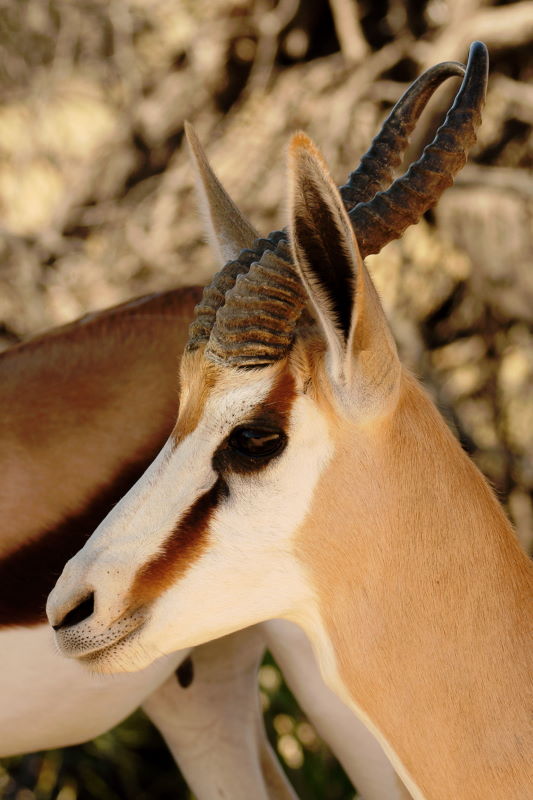
Having had the excitement of the lions at lunchtime we moved back to our camp, on the way we passed a large herd of springbok right on the roadside. This opportunity allowed me to get a real close-up of some of these iconic animals.
Then when we arrived back at the camp there waiting for us at the drinking hole were a herd of giraffe. I watched with interest as these tall animals, that can look so graceful as they wander around the veld, akwardly reach down to get a drink. The shot of this one below had me holding my breath as its legs went wider and wider, occasionally slipped in the mud around the hole and seemed to have incredible flexibility as they bent under the weight and angle, forced by the massive distance the giraffe needs to come down to drink.
The Lanner falcons were also busy around the waterhole, swooping in try to catch a pigeon or two.

Also hanging around trying to look dis-interested were the fork-tailed drongos.


As the afternoon moved on we decided to go out for a short drive. The first new sighting we had was this Capped Wheatear

And then we spotted this little darlings of the desert! The bat-eared foxes. They were just a little too far away and moving further away, and the light was dropping so I struggled to get a decent shot of them, but this one illustrates their classic pose as they search of their evening meals.

We then headed back to camp. Shortly after we arrived back, the giraffe that had been at the waterhole earlier had been replaced by a large herd of wildebeest. I counted more than fifty in this image below, and that was not all of them.

We then settle down to review the photos we'd been taking and prepare for supper. Here is Claire Marie, my younger daughter looking through her pic's from the day.

And of course as it started to get darker, and the moths and other insects were attracted to our lights the geckos came out to feast with us!

I think thats all for this post ... its taken me way too long to get it finished!

all the best
Ivan
http://www.andersen.co.za/

Thursday, May 6, 2010

In and around Urikaruus ... part 2

Relaxing on the veranda of our unit looking over the waterhole in front, wondering what might come along next, I was surprised by this tiny little fuit fly (Rhacochlaena pulchella Bezzi 1920 (Tephritidae: Adramini)) and some of its friends!

I'm not sure if it was after the sweat / salt or dry skin on my leg .... yes, that's my leg it is sitting on! But it did not seem to bite or sting, and when I zoomed in I was amazed at its colours and detail. This prompted me to start looking around for some other smaller occupants of the camp.

The next resident I discovered was this kite spider, she had built her web on the side of the kitchen unit, between it and our bedroom unit.
And what an amazing web. I tried to get a shot that would illustrate the density and complexity of this web. Theses are the best I could do.


The spider you see on the image on the top of the three above, is the black blob on the end of the sausage looking object, more or less in the middle of the image on the left (vertically) and on the left side (horizontally). The image to the right of the two lower images is a landscape crop of the left side image. If you look closely and use your imagination you can see the spider. But what I'm really trying to illustrate here is the density and complexity of her web. Other than webs of sociable spiders, which I'll post later this web has to be the most complex I've seen developed by a single spider.

Another regular visitor at this unit was the Kalahari Tree Skink. There were various members of this family around. This old chap looked rather as if he/she had survived a few wars! But none-the-less was relatively relaxed around us, and would check in every now and again to see if something interesting had been dropped for it to eat.

Then just to round off this post and the day, I spotted this little web glistening in the setting sun. I never discovered the occupant as it was quite high in a tree, and out of reach from the chalet veranda. I liked the way the sunlight picked up the strands, and I think it was possibly another kite spider.

And then to finish this post, one of the other regulars where ever we went. The yellow mongoose, put in and appearance, always alert always interested.

all the best,

Ivan


Tuesday, April 20, 2010

In the park ... at last

Well, finally we arrived at the gates into the Kgalagadi Transfrontier park. The check-in went smoothly, although one could clearly see we were no longer in a fast-paced city, but out on the fringes of the desert (and the edge of civilization!). Nothing was done in any kind of hurry, or with any form of urgency..... but it was done, and in a reasonably friendly manner.


Then off to our chalet just accross the way. Interestingly this reception area is also a border post between South Africa and Botswana, and due to the renovations and developments taking place you actually cross over into the Botswana section to go around to the rest camp, which is back on the South African side.
This is a view of the chalets on the Botswana side from the South African camp.


Taken as the sun was setting, so you can see the sun reflecting off the chalets, with the dark clouds in the background. Interestingly, one of the things Ria had said, was that she would love to be in the Kalahari when it rains! Well, she got her wish, it actually rained three time whilst we were there!

One of the first animals we saw once we were in the park was this:


The yellow mongoose. I was quite excited but came to realise as the trip went on, that these little animals have become quite habituated to humans in the camps and are frequently seen scavenging around for tidbits.

The Yellow Mongoose (Cynictis penicillata), sometimes referred to as the Red Meerkat, is a small mammal averaging about 1 lb (1/2 kg) in weight and about 20 in (500 mm) in length. A member of the mongoose family, it lives in open country, from semi-desert scrubland to grasslands in Angola, Botswana, South Africa, Namibia, and Zimbabwe.
As many as twelve subspecies of yellow mongoose have been described. In general, the yellow mongoose has lighter highlights on the underbelly and chin, a bushy tail, and a complete lack of sexual dimorphism. Southern yellow mongooses are larger, have yellow or reddish fur, longer fur, and a longer tail with a characteristic white tip. Northern subspecies tend towards smaller size, grey colouration, a grey or darker grey tip to the tail, and shorter hair more appropriate to the hotter climate.
The yellow mongoose is carnivorous, consuming mostly arthropods but also other small mammals, lizards, snakes and eggs of all kinds. (credit wikipedia)


Another of the regulars one sees in the evenings and early mornings are the geckos, they tend to go to the lights so they can catch the numerous insects that flock to them at night:


This is Bibron's gecko (Pachydactylus bibronii) and is a moderate-sized gecko that when fully grown reaches between 6 and 8 inches. It has a stockier build than most other geckos. The female is generally smaller than the male. Its base color is brown, and it has a beaded pattern dorsally, with horizontal black strips and white dots. The belly is white or very light brown. Newly-hatched Bibron's geckos' line and color patterns look solid while the adults' appear to be more broken. The female sometimes lacks the white dots.
Bibron's gecko is arboreal and ground-dwelling. It is territorial, and males are very aggressive toward each other. Individuals can commonly be found missing appendages in the wild. The female usually lays two clutches per year, with two eggs per clutch. These geckos are very fast runners. Also, they are good at hiding in leaves or on rocks.

This species is distributed across the southern part of the African continent. It is common in South Africa, where it is one of the largest gecko species. (credit wikipedia).

After a nice meal, we settled down for our first night in the park. Only to be woken up a little later with bats flying around inside our chalet!, Well there didn't seem to be much that we could do about it so we went back to bed. We woke up the floowing morning to find that Ria's bed had been the target of the bats latrine activity over night .....eeeoww! Anyway we were up and washed, and headed off to the next camp: Mata Mata some +-120km away, over dirts roads with a speed limit of 50km per hour, and hopefully some interesting game viewing along the way. But that's for another post.

all the best
Ivan
http://www.andersen.co.za/
All content of this blog is copyright owned by Ivan Andersen. Should you wish to use any text or images, please request permission by contacting the author.