Showing posts with label digital. Show all posts

Monday, May 24, 2010

The Urikaruus story continues

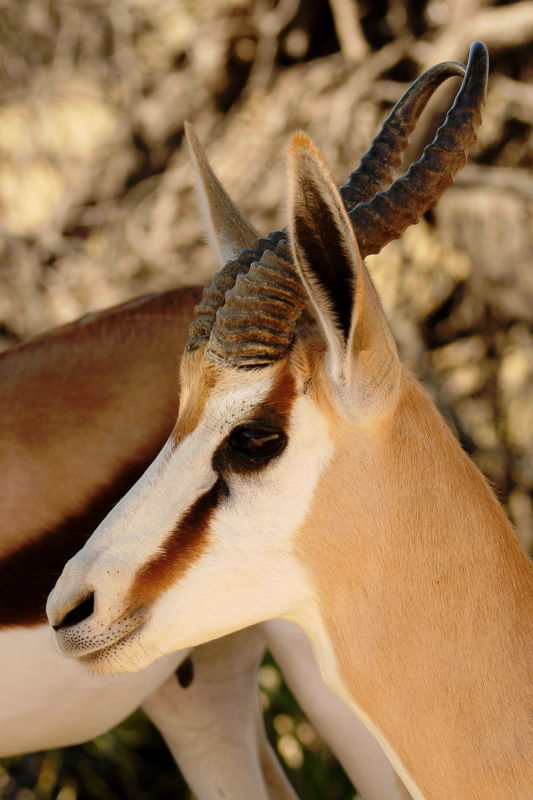
Having had the excitement of the lions at lunchtime we moved back to our camp, on the way we passed a large herd of springbok right on the roadside. This opportunity allowed me to get a real close-up of some of these iconic animals.
Then when we arrived back at the camp there waiting for us at the drinking hole were a herd of giraffe. I watched with interest as these tall animals, that can look so graceful as they wander around the veld, akwardly reach down to get a drink. The shot of this one below had me holding my breath as its legs went wider and wider, occasionally slipped in the mud around the hole and seemed to have incredible flexibility as they bent under the weight and angle, forced by the massive distance the giraffe needs to come down to drink.
The Lanner falcons were also busy around the waterhole, swooping in try to catch a pigeon or two.

Also hanging around trying to look dis-interested were the fork-tailed drongos.


As the afternoon moved on we decided to go out for a short drive. The first new sighting we had was this Capped Wheatear

And then we spotted this little darlings of the desert! The bat-eared foxes. They were just a little too far away and moving further away, and the light was dropping so I struggled to get a decent shot of them, but this one illustrates their classic pose as they search of their evening meals.

We then headed back to camp. Shortly after we arrived back, the giraffe that had been at the waterhole earlier had been replaced by a large herd of wildebeest. I counted more than fifty in this image below, and that was not all of them.

We then settle down to review the photos we'd been taking and prepare for supper. Here is Claire Marie, my younger daughter looking through her pic's from the day.

And of course as it started to get darker, and the moths and other insects were attracted to our lights the geckos came out to feast with us!

I think thats all for this post ... its taken me way too long to get it finished!

all the best
Ivan
http://www.andersen.co.za/

Wednesday, May 19, 2010

In and around Urikaruus - part 5

Well having given you some bugs (spiders!) and birds in my previous post, we'll move to the bigger beasts again for a while! As I had said we were told that there had been a kill just 8km from our camp. There were apparently four lions (Panthera leo) that had taken down a blue wildebeest (Connochaetes taurinus), and were busy eating it near the road. Now I must warn you, some of the images I will post here you may find a little upsetting or disturbing. It is not my intent to do either, but to simply illustrate what we saw and how nature operates in these wilderness areas. If this concerns you, please skip this post and come back tomorrow when I've posted the next installment!

So we headed off in the direction towards Mata Mata hoping that the lions would still be there and we'd be able to see them nice and close. We had seen lion a few days earlier, but they were so far away and lying still in the shade, so we could not get a decent view, never mind a picture, of them.

Well, just as described about 8km up the road we came across the lions and their prize!
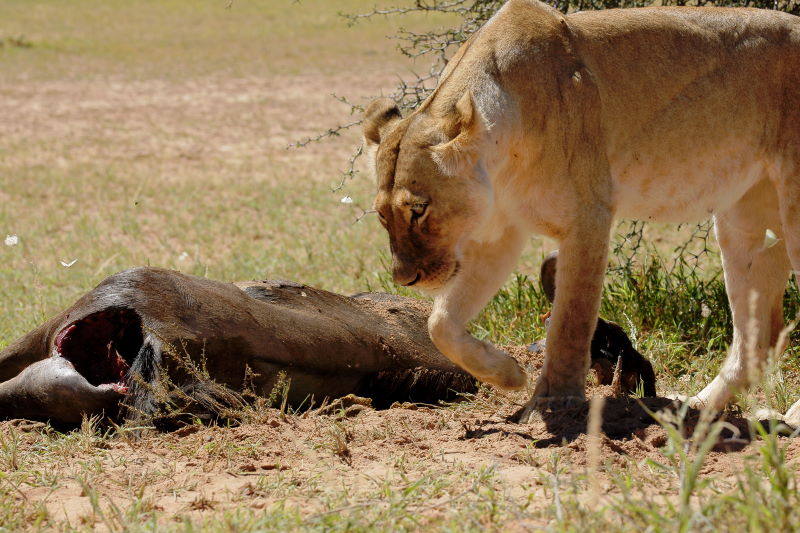
This picture is of the younger female (in the foreground), and the two young males behind her. There were fours lions in total. Two older females and two young males. The three in the image above were lying right on the side of the road. The sandbank you can see in the foreground of the picture is the edge of the road!

The older of the two females was still nibbling at the carcass of the wildebeest. From this picture and the one following it you can see that the lions had eaten the rump and stomach areas of the wildebeest.

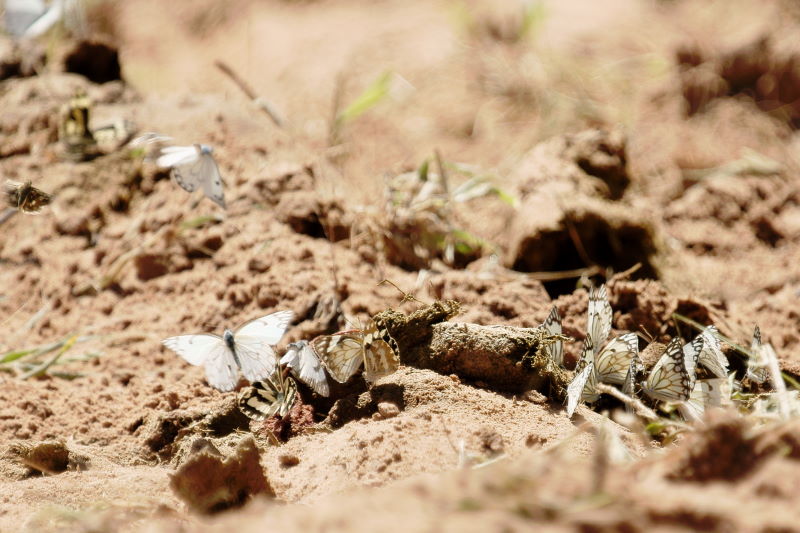
But what I found facinating were the butterflies that hovered around the kill area. Clearly in a world where moisture is at a premium these delicate creatures find something of value in the fluids distributed after a kill like this. Did you notice them in the images above? Take another look, click on the image to get a larger view.


After this lioness had eaten a little more she nochalantly picked up the carcass in her moth and dragged it into the shade of the nearby thorn tree. Now an adult wildebeest, which this clearly was, can weigh anything up to 274kg and the maximum weight a female lion is likely to reach is only 182kg. Ok, sure they had eaten a significant amount of meat off the carcass, but chances are that what remained was as heavy if not heavier than the lioness.

Here she is clearly enjoying another nibble after the exertion of moving the carcass.
What followed next was also, for me, an interesting interaction. Firstly, the lions, all four of them, seemed totally unperturbed and uninterested in the four or five vehicles that had gathered around their lunch table, despite the close proximity. Plus the camera lenses sticking in their faces and clicking sounds of photos been taken and the hum of voices from the various ocupants in the vehicles, all seemed to be of absolutely no interest to the lions at all. But I digress! The lioness that was at the carcass had gotten up and one of the young males had started to move towards her and the wildebeest. 

As he moved past the lioness that had been lying in the shade beside the road with him, he lent down and rubbed his face against hers as she lay there, totally unmoved.   He then moved towards the other lioness near the carcass, her reaction was completely different! She pulled back her ears and snarled at him!
 He simply responded by turning around again and going to lie back down where he had been before!
Just as a matter of interest, for those of you that are a little technical, the shot above of the snarling lioness was taken with 160mm focal length and has not been cropped at ALL. In fact the only shots cropped in this post are the one of the butterflies and the portrait of the male cub. That's how close we were to the action!

all the best

Ivan

Tuesday, May 18, 2010

In and around Urikaruus - part 4

As I mentioned in my previous post this day started well and steadily improved! Firstly I had spotted the this spider


and her web in the early morning light, then as I moved around I saw this one in a bush nearby. Do you see the curious ant possibly heading into the danger zone?


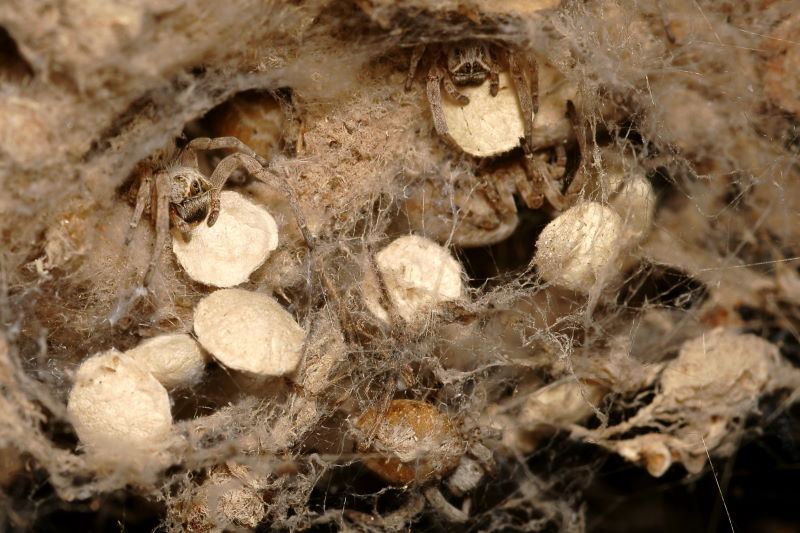
This spider, I think is a member of the sociable web spider family, or community nest spider family. This one was starting a relatively new nest I think. I had seen these nests alnode the road and in the camp and had wondered if they were still inhabited as had been unable to see any spiders in them. On top of this most of the nests I saw appeared so encrusted with dust I wondered if anything could live in there!

Then I spotted these spiders peeking out of this nest. They appeared to have a number of eggsacs too. Here is a closer crop of the photo above.


Enough of spiders .... for now! The day moves on, and we are visited by some large herds of springbok, and some wildebeest. The image below captures part of the herd only!

We counted well over 200 animals in this herd. Then I spotted a crimson-breasted shrike an image of which I posted earlier, and still I was not able to get a really nice shot of this stunning bird.


But here it is again, just because I think the colours are so amazing, even though the shot is lousy! One of the friendly familiar chats popped in too,


as did the glossy starling and of course the sparrow-weaver and family.


Then a fork-tailed drongo came by.


A group of Namaqua Sandgrouse (Pterocles namaqua)  were also making regular visits to the waterhole.

Flying high and calling with their characteristic whistle. We also saw a juvenile marshall eagle and a black-breasted snake eagle. Neither of which came close enough to allow me a decent shot, but I did get pictures of both at other occasions.

Of course the ground squirrels were also doing their usual foraging around, with their portable shade umbrellas working overtime in the harsh light of the mid-morning sun

And then ...... the camp attendant came to tell us that some of the other guests had just returned from a drive and had seen some lion with a kill not far from our camp. So we got a few things together and jumped into the car. But I'll save that story for my next post!

all the best
Ivan

Monday, May 17, 2010

In and around Urikaruus - part 3

Well day two (April 2nd 2010) dawned in Urikaruus, this was after an interesting evening sitting on the veranda cooking our evening meal on an open fire. As night was starting to set in my daughter Claire Marie spotted (no pun intended :-) ) a leopard strolling down out of the bush, almost directly opposite from us, towards the watering hole. She, that is the leopard, was quite nonchalant and disinterested in the hum of exitement stemming from these wide-eyed invaders of what was clearly her home territory. Unfortunately it was too dark, and she was too far away to get any kind of photo of her, so we just sat and watched in the gathering gloom, for as long as we could see her and then returned to our evening meal, as she set off to find hers.

Well, having spent so much time in the car over the first few days of our trip we decided to relax on this morning and see what may make an appearance in and around our camp. I tried to get a few landscape shots from our bedroom veranda just after the sun rose, but I won't bore you with those attempts having already posted some views in my earlier post. Having looked out front and not seen much other than the great view, I then turned my attention to behind the chalet and saw this in the rays of the rising sun!


It must have been there the day before, but it needed the early morning light to reveal it to my human eyes. What an amazing web! The top anchor line stretched probably nearly two metres, you can see it running almost horizontally accross the top of the image. The overall web was about 40-50cm high and about double that in horizontal diameter. One of the amazing things about this web was that it was virtually invisible once the sun got up into the sky.  If you look really closely you can see the spider in the top left part of the middle circle of the web. It just give you a perspective on the size of construction this little lady made!


Still struggling to see her? Well, here's an even closer view.


What amazing colours and shapes she has. She blends in with the natural surrounds incredibly well too.

I'll leave this post here, but this day started well and got better and better. So stay around and I'll tell you more :-)

all the best,
Ivan
http://www.andersen.co.za/

Thursday, May 6, 2010

In and around Urikaruus ... part 2

Relaxing on the veranda of our unit looking over the waterhole in front, wondering what might come along next, I was surprised by this tiny little fuit fly (Rhacochlaena pulchella Bezzi 1920 (Tephritidae: Adramini)) and some of its friends!

I'm not sure if it was after the sweat / salt or dry skin on my leg .... yes, that's my leg it is sitting on! But it did not seem to bite or sting, and when I zoomed in I was amazed at its colours and detail. This prompted me to start looking around for some other smaller occupants of the camp.

The next resident I discovered was this kite spider, she had built her web on the side of the kitchen unit, between it and our bedroom unit.
And what an amazing web. I tried to get a shot that would illustrate the density and complexity of this web. Theses are the best I could do.


The spider you see on the image on the top of the three above, is the black blob on the end of the sausage looking object, more or less in the middle of the image on the left (vertically) and on the left side (horizontally). The image to the right of the two lower images is a landscape crop of the left side image. If you look closely and use your imagination you can see the spider. But what I'm really trying to illustrate here is the density and complexity of her web. Other than webs of sociable spiders, which I'll post later this web has to be the most complex I've seen developed by a single spider.

Another regular visitor at this unit was the Kalahari Tree Skink. There were various members of this family around. This old chap looked rather as if he/she had survived a few wars! But none-the-less was relatively relaxed around us, and would check in every now and again to see if something interesting had been dropped for it to eat.

Then just to round off this post and the day, I spotted this little web glistening in the setting sun. I never discovered the occupant as it was quite high in a tree, and out of reach from the chalet veranda. I liked the way the sunlight picked up the strands, and I think it was possibly another kite spider.

And then to finish this post, one of the other regulars where ever we went. The yellow mongoose, put in and appearance, always alert always interested.

all the best,

Ivan


Thursday, April 22, 2010

In and around Mata Mata

Having arrived reasonably early in Mata Mata, we took the opportunity to relax, have a swim and stretch our legs a bit. Having now spent the best part of 24hrs in the car over the last three days! We unfortunately had only managed to book a single night here too, so we would be back on the road in the morning, but fortuately not so far this time, about 60km back on the road we travelled to a camp called Urikaruus.

Anyway, once again I'm getting ahead of myself!
Mata Mata ...

A pleasant camp, still quite large with a number of chalets and a camping area. This camp is fenced off from the park, has a small swimming pool, petrol station, small shop and reception.


Yep, thats me and Claire Marie (in front of me) and Gayle (on the edge of the photo). As you can see the pool was not sparkling blue and clean, but it WAS wet, and cool. A big relief after the hot days we'd spent in the car and on the road.

After our swim we were relaxing on the veranda of our chalet, when I spotted a Crimson-breasted Gonolek (formerly Crimson-breasted Shrike) Laniarius atrococcineus, it is an African bird occurring in a broad swathe from southern Angola to the Free State in South Africa. This shrike is extremely nimble and restless, its penetrating whistles being heard far more often than the bird is seen, its bright colour notwithstanding. The sexes have the same colouration and are indistinguishable from each other. A yellow-breasted form is occasionally seen, and was at first thought to be a separate species. (credit wikipedia).

As it says in wikipedia, this bird does not pose for you, it is always on the move. It is however, beautiful! I'm on a mission to try and get a really good picture of it still. Here is my best one from this trip.


Then of course we were visited by the local residents .... the Cape Ground Squirrel (Xerus inauris) is found in most of the drier parts of southern Africa from South Africa, through to Botswana, and into Namibia.
The name Cape Ground Squirrel is somewhat misleading as it actually has a much wider area of habitation. This common name may have been arrived at to distinguish it from a tree squirrel (the Eastern Grey Squirrel) found around Cape Town, which was imported from Europe by Cecil John Rhodes. (credit wikipedia)


Then there are the other little regulars, these cute little birds are so aptly named, Familiar Chats! You'll see them all over the country, and they'll aways be around hopping all over flicking their wings.
 
The Familiar Chat, Cercomela familiaris, is a small passerine bird of the Old World flycatcher family Muscicapidae. It is a common resident breeder in Africa south of the Sahara in rocky and mountainous habitat and around human habitation. (credit wikipedia)
 
As it started to get dark we settled down the the serious buiness of cooking supper!
 
That's all for now.
 
all the best
Ivan
http://www.andersen.co.za/

Wednesday, April 21, 2010

The road to Mata Mata

As we drove out of the Twee Rivieren camp on Wednesday just after 8am in the morning, Ria and I had switched roles. She was now driving and I was sitting in the passenger seat with my camera. Every hopeful of some exciting sitings. We were a little wary of the amount of time that it potentiall could take us to get to Mata Mata, even though it was "only" 120km away. As I described in my earlier posts we had already spent almost two full days travelling in the car just to get here, and all of us were somewhat travel weary.

The first aminals we saw on our drive that morning was to be one of the icons of the Kalahari, the Gemsbok.

I think if you have not seen one of these, and taken a photo of it, you have not been to the Kgalagadi! They are beautiful and amazing creatures.

The gemsbok or gemsbuck (Oryx gazella) is a large African antelope, of the Oryx genus.
Gemsbok are mainly desert-dwelling and do not depend on drinking to supply their physiological water needs, but many of the northern Gemsbok live in open grasslands where water is readily available. (credit wikipeadia)

Gemsbok are able to increase their body temperature to 45 degrees from 35.7 degrees C in order to delay evaporative cooling. (credit http://animaldiversity.ummz.umich.edu/site/accounts/information/Oryx_gazella.html)

They do become, however a very common sight as we experienced on this trip.
 
The next thing we saw was a Kori Bustard:
 
 
The Kori Bustard (Ardeotis kori) is a large bird native to Africa. It is a member of the bustard family. It may be the heaviest bird capable of flight, although this title may also belong to the similarly-dimensioned Great Bustard. The male Kori Bustard averages about 110 cm (3.6 ft) in length, stands 60–90 cm (2.0–3.0 ft) tall and have a wingspan about 230-275 cm. An average male bird would weigh about 12.4 kg (27 lb), but exceptional birds may weigh over 20 kg (44 lb). The female Kori Bustard averages 5.7 kg (13 lb) and is usually 20% shorter than a male. (credit wikipedia)
 
Then we spotted a black-backed jackal strolling through the veld, with a couple of curious ground squirrels (Xerus inauris) looking on.
 
 
Both these animals were to become regular sightings for us too. Then we spotted these Namaqua Sandgrouse (Pterocles namaqua) is a species of bird in the Pteroclididae family. The male has the plain coloured neck. They tend to flock in numbers to the water holes.
 
 
The next animals we saw are also in abundance, and are also, in my opinion icons of the Kalahari. The BlueWildebeest (Connochaetes taurinus) and Springbok (Antidorcas marsupialis). Often seen together, these animals are seen in herds of many hundred animals at a time, however you also see lone males of both quite often.
 
 
And then we spotted some real excitement. Three cheetah (Acinonyx jubatus) with a springbok they had recently captured. They were lying under a tree with their meal, some 75m or so away from the road.
 
We sat and watched these cheetahs, who we extremely relaxed and not at all interested in the four or five vehicle loads of humans, pointing various optical devices at them!
 
We then moved on and spotted these swallow-tailed bee-eaters (Merops hirundineus).
 
 
Next on the agenda were giraffe, and lots more springbok, and some wildebeest. The daytime temperatures we starting to hot up some many of the animals we seeking shade. This large herd of springbok, with the giraffe and wildebeest mingling was well over 130 animal strong!
 

I count 132 just in this bottom image alone, and there were many other spread along the base of this little koppie, as can been seen in the image above.
 
And finally, at least for this post another two birds I came to identify as regulars in this region. The Pale Chanting Goshawk, and the Secretary bird. Not my best images of either, but I'll save those for a later post.
 
The Secretary bird, I have subsequently discovered is quite unique:
The Secretarybird or Secretary Bird (Sagittarius serpentarius) is a large, mostly terrestrial bird of prey. Endemic to Africa, it is usually found in the open grasslands and savannah of the sub-Sahara. Although a member of the order Accipitriformes, which also includes many other diurnal raptors such as kites, buzzards, vultures, and harriers, it is given its own family, Sagittariidae. (credit wikipedia)
 
 
We pulled into the Mata Mata reception at about 2:30pm that afternoon. A good day all-in-all.
 
All the best
Ivan
http://www.andersen.co.za/
All content of this blog is copyright owned by Ivan Andersen. Should you wish to use any text or images, please request permission by contacting the author.