Showing posts with label Ardeotis kori. Show all posts

Monday, June 7, 2010

On the road to Nossob

After a leisurely start to the morning we packed up and moved off from Urikaruus around 9am, to head off to our next camp which is to be Nossob. This camp is about 100km from Urikaruus and we anticpated that it would take us the best part of the day to get there.

Not far out of camp we spotted this little mongoose.
I unfortunately cut off the tip of its tail in this image, and this was the best shot I got, as this little chap was very busily going about his business and hardly stood still for a moment!

The road between the Mata Mata road and Dikbaardskolk was probably the worst we'd experienced in the park, and in fact turned out to be the worst section we drove on in our entire trip. Sections were so corrugated we really felt like we were getting shaken to bits! But, we weren't about to let that spoil this great trip. You are warned about the roads in this park when you book and at the various camps you are advised to deflate your tyres to as little as 1.2bar, to minimize the impact and both the raods and your travelling comfort!

Next we spotted this black-headed heron sitting on the edge of a water reservoir. It was making an interesting movement with its throat, but did not appear to be making any sound that we could hear.

To be honest by this time I had grown tired of taking photos of springbok, gemsbok and wildebeest and would only take if there was something unique in the shot that we had not seen before. A little while later I spotted a couple of Lanner Falcons sitting on a tree, they were unfortunately a little too far away to get a decent picture of, so I won't bore you with a poor quality image. Then we saw a kori bustard, now we had seen quite a few of this majestic birds, but I still had not really succeeded in geeting a nice clear shot as they seemed quite wary of the motor vehcile and always started to move off as we got closer. Perhaps it was all the rattling and creaking my poor old Sani was developing on these roads? ;-)


Then, at last, we saw a pale chanting goshawk in a thorn tree right next to the road. Now, if you've read my previous posts you'll know I'd been wanting to get a nice clear shot of one of these birds. They had also become almost iconic, at least in my mind, with respect to the Kgalagadi. So here are two of the shots I took.


Then we saw a black-cheasted snake eagle, it was a little too far to get a great shot but I quite liked this one as it shows the starkness of the landscape and the clarity of the sky.

A short while later we saw this greater kestrel, this was the first time we had been able to identify this bird, on this trip, and it was the only chance I got to take a photo of it.

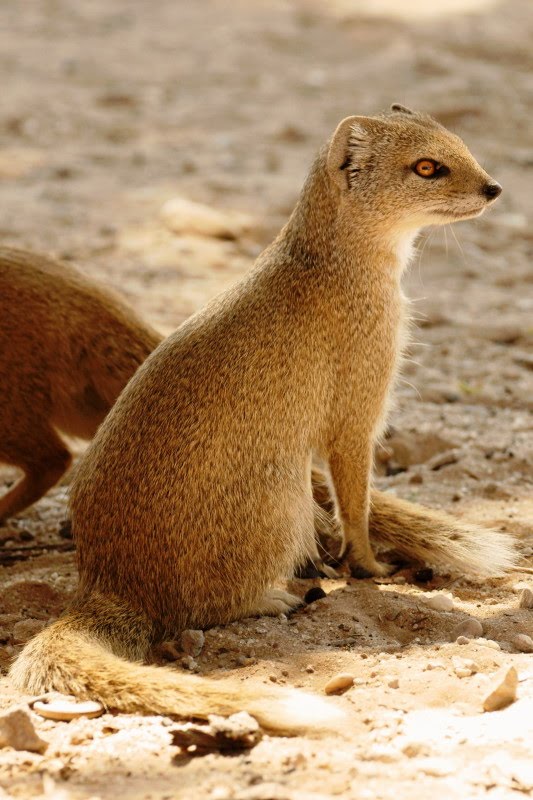
By now we were almost half way through the mornings trip. It had not taken quite as long as we'd expected, but we were feel somewhat shaken and not really stirred! We arrived at the Dikbaardskolk picnic spot and decided to get out and rest a while. As with most of the (human) inhabited spots in the park, this was no different and the yellow mongoose were ever present looking for a tidbit of any sort.
The balance of the trip into Nossob was fairly quite and we did not see much at all. We arrived at the camp at about 13:35, sooner than we had expected, but defintely not sooner than we'd wished after rattling to bits for a couple of hours! (But that's another story)!

all the best,
Ivan
http://www.andersen.co.za/

Wednesday, April 21, 2010

The road to Mata Mata

As we drove out of the Twee Rivieren camp on Wednesday just after 8am in the morning, Ria and I had switched roles. She was now driving and I was sitting in the passenger seat with my camera. Every hopeful of some exciting sitings. We were a little wary of the amount of time that it potentiall could take us to get to Mata Mata, even though it was "only" 120km away. As I described in my earlier posts we had already spent almost two full days travelling in the car just to get here, and all of us were somewhat travel weary.

The first aminals we saw on our drive that morning was to be one of the icons of the Kalahari, the Gemsbok.

I think if you have not seen one of these, and taken a photo of it, you have not been to the Kgalagadi! They are beautiful and amazing creatures.

The gemsbok or gemsbuck (Oryx gazella) is a large African antelope, of the Oryx genus.
Gemsbok are mainly desert-dwelling and do not depend on drinking to supply their physiological water needs, but many of the northern Gemsbok live in open grasslands where water is readily available. (credit wikipeadia)

Gemsbok are able to increase their body temperature to 45 degrees from 35.7 degrees C in order to delay evaporative cooling. (credit http://animaldiversity.ummz.umich.edu/site/accounts/information/Oryx_gazella.html)

They do become, however a very common sight as we experienced on this trip.
 
The next thing we saw was a Kori Bustard:
 
 
The Kori Bustard (Ardeotis kori) is a large bird native to Africa. It is a member of the bustard family. It may be the heaviest bird capable of flight, although this title may also belong to the similarly-dimensioned Great Bustard. The male Kori Bustard averages about 110 cm (3.6 ft) in length, stands 60–90 cm (2.0–3.0 ft) tall and have a wingspan about 230-275 cm. An average male bird would weigh about 12.4 kg (27 lb), but exceptional birds may weigh over 20 kg (44 lb). The female Kori Bustard averages 5.7 kg (13 lb) and is usually 20% shorter than a male. (credit wikipedia)
 
Then we spotted a black-backed jackal strolling through the veld, with a couple of curious ground squirrels (Xerus inauris) looking on.
 
 
Both these animals were to become regular sightings for us too. Then we spotted these Namaqua Sandgrouse (Pterocles namaqua) is a species of bird in the Pteroclididae family. The male has the plain coloured neck. They tend to flock in numbers to the water holes.
 
 
The next animals we saw are also in abundance, and are also, in my opinion icons of the Kalahari. The BlueWildebeest (Connochaetes taurinus) and Springbok (Antidorcas marsupialis). Often seen together, these animals are seen in herds of many hundred animals at a time, however you also see lone males of both quite often.
 
 
And then we spotted some real excitement. Three cheetah (Acinonyx jubatus) with a springbok they had recently captured. They were lying under a tree with their meal, some 75m or so away from the road.
 
We sat and watched these cheetahs, who we extremely relaxed and not at all interested in the four or five vehicle loads of humans, pointing various optical devices at them!
 
We then moved on and spotted these swallow-tailed bee-eaters (Merops hirundineus).
 
 
Next on the agenda were giraffe, and lots more springbok, and some wildebeest. The daytime temperatures we starting to hot up some many of the animals we seeking shade. This large herd of springbok, with the giraffe and wildebeest mingling was well over 130 animal strong!
 

I count 132 just in this bottom image alone, and there were many other spread along the base of this little koppie, as can been seen in the image above.
 
And finally, at least for this post another two birds I came to identify as regulars in this region. The Pale Chanting Goshawk, and the Secretary bird. Not my best images of either, but I'll save those for a later post.
 
The Secretary bird, I have subsequently discovered is quite unique:
The Secretarybird or Secretary Bird (Sagittarius serpentarius) is a large, mostly terrestrial bird of prey. Endemic to Africa, it is usually found in the open grasslands and savannah of the sub-Sahara. Although a member of the order Accipitriformes, which also includes many other diurnal raptors such as kites, buzzards, vultures, and harriers, it is given its own family, Sagittariidae. (credit wikipedia)
 
 
We pulled into the Mata Mata reception at about 2:30pm that afternoon. A good day all-in-all.
 
All the best
Ivan
http://www.andersen.co.za/
All content of this blog is copyright owned by Ivan Andersen. Should you wish to use any text or images, please request permission by contacting the author.