Showing posts with label wildebeest. Show all posts

Wednesday, May 19, 2010

In and around Urikaruus - part 5

Well having given you some bugs (spiders!) and birds in my previous post, we'll move to the bigger beasts again for a while! As I had said we were told that there had been a kill just 8km from our camp. There were apparently four lions (Panthera leo) that had taken down a blue wildebeest (Connochaetes taurinus), and were busy eating it near the road. Now I must warn you, some of the images I will post here you may find a little upsetting or disturbing. It is not my intent to do either, but to simply illustrate what we saw and how nature operates in these wilderness areas. If this concerns you, please skip this post and come back tomorrow when I've posted the next installment!

So we headed off in the direction towards Mata Mata hoping that the lions would still be there and we'd be able to see them nice and close. We had seen lion a few days earlier, but they were so far away and lying still in the shade, so we could not get a decent view, never mind a picture, of them.

Well, just as described about 8km up the road we came across the lions and their prize!
This picture is of the younger female (in the foreground), and the two young males behind her. There were fours lions in total. Two older females and two young males. The three in the image above were lying right on the side of the road. The sandbank you can see in the foreground of the picture is the edge of the road!

The older of the two females was still nibbling at the carcass of the wildebeest. From this picture and the one following it you can see that the lions had eaten the rump and stomach areas of the wildebeest.
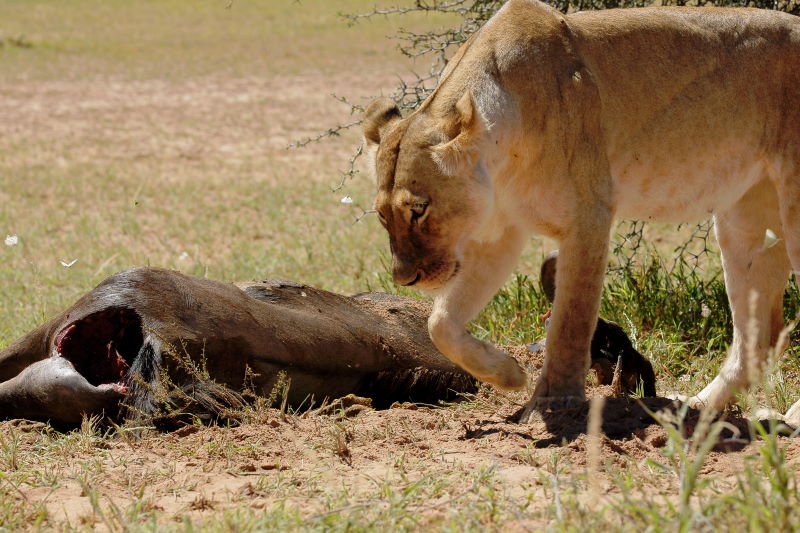
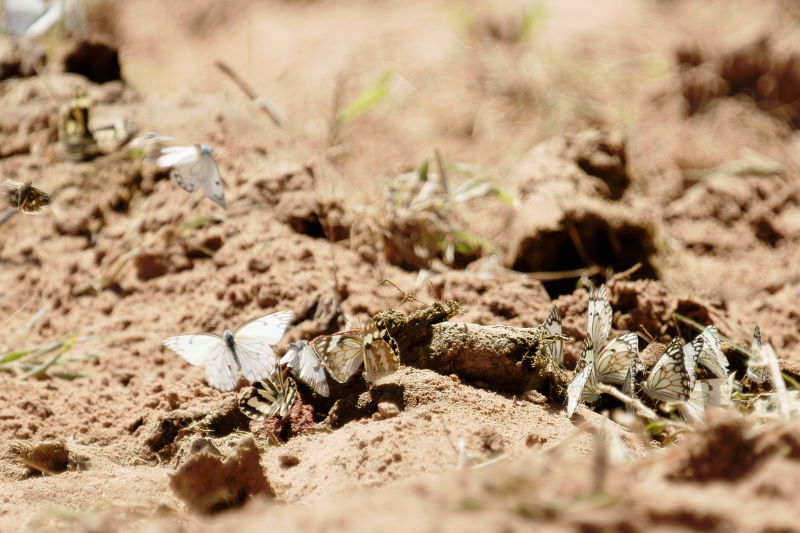
But what I found facinating were the butterflies that hovered around the kill area. Clearly in a world where moisture is at a premium these delicate creatures find something of value in the fluids distributed after a kill like this. Did you notice them in the images above? Take another look, click on the image to get a larger view.

After this lioness had eaten a little more she nochalantly picked up the carcass in her moth and dragged it into the shade of the nearby thorn tree. Now an adult wildebeest, which this clearly was, can weigh anything up to 274kg and the maximum weight a female lion is likely to reach is only 182kg. Ok, sure they had eaten a significant amount of meat off the carcass, but chances are that what remained was as heavy if not heavier than the lioness.

Here she is clearly enjoying another nibble after the exertion of moving the carcass.
What followed next was also, for me, an interesting interaction. Firstly, the lions, all four of them, seemed totally unperturbed and uninterested in the four or five vehicles that had gathered around their lunch table, despite the close proximity. Plus the camera lenses sticking in their faces and clicking sounds of photos been taken and the hum of voices from the various ocupants in the vehicles, all seemed to be of absolutely no interest to the lions at all. But I digress! The lioness that was at the carcass had gotten up and one of the young males had started to move towards her and the wildebeest. 

As he moved past the lioness that had been lying in the shade beside the road with him, he lent down and rubbed his face against hers as she lay there, totally unmoved.   He then moved towards the other lioness near the carcass, her reaction was completely different! She pulled back her ears and snarled at him!
 He simply responded by turning around again and going to lie back down where he had been before!
Just as a matter of interest, for those of you that are a little technical, the shot above of the snarling lioness was taken with 160mm focal length and has not been cropped at ALL. In fact the only shots cropped in this post are the one of the butterflies and the portrait of the male cub. That's how close we were to the action!

all the best

Ivan

Tuesday, May 4, 2010

In and around Urikaruus

Whew, its been a mission getting back on-line after all the disruptions to our local internet services. Hopefully that's behind us now.

Urikaruus, a cute little camp as I said previously. We were treated to some very warm (not surprisingly) weather during our stay here. This was the first camp that we were to spend more than a single night at. It was great to settle in and feel that there was no pressure to move on again.

As I described in my previous post, the units faced out into what I suppose may have been an old river bed, long since dried-up, now with a man made watering hole put in place to provide the resident animals with some place to get a drink! And come and drink they did!


The main visitors were the blue wildebeest (Connochaetes taurinus) and springbok (Antidorcas marsupialis), and they came in numbers! Some of the herds were well over 100 animals strong. We also had giraffe (Giraffa camelopardalis), a number of different bird species, the Lanner Falcons (Falco biarmicus) were there daily catching either Namaqua doves (Oena capensis), Cape turtle doves (Streptopelia capicola) or Sandgrouse (Pterocles namaqua). Here are two lanner falcons that had just caught another bird and were eating it on a dead tree just to the right of our chalet.


The White-browed sparrow-weaver (Plocepasser mahali) and Cape Glossy starling (Lamprotornis nitens) were regular visitors on our veranda.

The sparrow-weaver and his wife and child and obviously become VERY habituated to the humans residing here, and vocally demanded to be fed on a regualr basis. They were so tame that I could touch them from time to time. We are strong believers in the fact that you MUST not feed the animals in the National Parks, so we would try to discourage these persistent little birds, but clearly others had been feeding them. Sad!

This little juvenile Laughing Dove Stigmatopelia senegalensis) had my daughters very concerned that it was too young to look after itself, but it seemed to be quite capable, and also very un-afraid of the human poking camera lenses in its face!

all the best
Ivan
http://www.andersen.co.za/


Wednesday, April 21, 2010

The road to Mata Mata

As we drove out of the Twee Rivieren camp on Wednesday just after 8am in the morning, Ria and I had switched roles. She was now driving and I was sitting in the passenger seat with my camera. Every hopeful of some exciting sitings. We were a little wary of the amount of time that it potentiall could take us to get to Mata Mata, even though it was "only" 120km away. As I described in my earlier posts we had already spent almost two full days travelling in the car just to get here, and all of us were somewhat travel weary.

The first aminals we saw on our drive that morning was to be one of the icons of the Kalahari, the Gemsbok.

I think if you have not seen one of these, and taken a photo of it, you have not been to the Kgalagadi! They are beautiful and amazing creatures.

The gemsbok or gemsbuck (Oryx gazella) is a large African antelope, of the Oryx genus.
Gemsbok are mainly desert-dwelling and do not depend on drinking to supply their physiological water needs, but many of the northern Gemsbok live in open grasslands where water is readily available. (credit wikipeadia)

Gemsbok are able to increase their body temperature to 45 degrees from 35.7 degrees C in order to delay evaporative cooling. (credit http://animaldiversity.ummz.umich.edu/site/accounts/information/Oryx_gazella.html)

They do become, however a very common sight as we experienced on this trip.
 
The next thing we saw was a Kori Bustard:
 
 
The Kori Bustard (Ardeotis kori) is a large bird native to Africa. It is a member of the bustard family. It may be the heaviest bird capable of flight, although this title may also belong to the similarly-dimensioned Great Bustard. The male Kori Bustard averages about 110 cm (3.6 ft) in length, stands 60–90 cm (2.0–3.0 ft) tall and have a wingspan about 230-275 cm. An average male bird would weigh about 12.4 kg (27 lb), but exceptional birds may weigh over 20 kg (44 lb). The female Kori Bustard averages 5.7 kg (13 lb) and is usually 20% shorter than a male. (credit wikipedia)
 
Then we spotted a black-backed jackal strolling through the veld, with a couple of curious ground squirrels (Xerus inauris) looking on.
 
 
Both these animals were to become regular sightings for us too. Then we spotted these Namaqua Sandgrouse (Pterocles namaqua) is a species of bird in the Pteroclididae family. The male has the plain coloured neck. They tend to flock in numbers to the water holes.
 
 
The next animals we saw are also in abundance, and are also, in my opinion icons of the Kalahari. The BlueWildebeest (Connochaetes taurinus) and Springbok (Antidorcas marsupialis). Often seen together, these animals are seen in herds of many hundred animals at a time, however you also see lone males of both quite often.
 
 
And then we spotted some real excitement. Three cheetah (Acinonyx jubatus) with a springbok they had recently captured. They were lying under a tree with their meal, some 75m or so away from the road.
 
We sat and watched these cheetahs, who we extremely relaxed and not at all interested in the four or five vehicle loads of humans, pointing various optical devices at them!
 
We then moved on and spotted these swallow-tailed bee-eaters (Merops hirundineus).
 
 
Next on the agenda were giraffe, and lots more springbok, and some wildebeest. The daytime temperatures we starting to hot up some many of the animals we seeking shade. This large herd of springbok, with the giraffe and wildebeest mingling was well over 130 animal strong!
 

I count 132 just in this bottom image alone, and there were many other spread along the base of this little koppie, as can been seen in the image above.
 
And finally, at least for this post another two birds I came to identify as regulars in this region. The Pale Chanting Goshawk, and the Secretary bird. Not my best images of either, but I'll save those for a later post.
 
The Secretary bird, I have subsequently discovered is quite unique:
The Secretarybird or Secretary Bird (Sagittarius serpentarius) is a large, mostly terrestrial bird of prey. Endemic to Africa, it is usually found in the open grasslands and savannah of the sub-Sahara. Although a member of the order Accipitriformes, which also includes many other diurnal raptors such as kites, buzzards, vultures, and harriers, it is given its own family, Sagittariidae. (credit wikipedia)
 
 
We pulled into the Mata Mata reception at about 2:30pm that afternoon. A good day all-in-all.
 
All the best
Ivan
http://www.andersen.co.za/
All content of this blog is copyright owned by Ivan Andersen. Should you wish to use any text or images, please request permission by contacting the author.